Towing a camper trailer is not just a simple
process of hooking up and taking off for your favourite camping
spot. As a duty of care to other road users there are a number
of rules and guideline limits you need to be aware of, otherwise
you could be breaking the law, voiding your vehicle warranty or
insurance in the event of an accident.
A vehicle and camper trailer must compliment each others maximum
capacities making for a safe combination in all situations. This
especially applies to lighter vehicles and soft roader 4wds
which have lighter tow capacities. If the ball weight is too
heavy, the tow vehicle's rear suspension will be forced down
affecting braking and also the vehicle’s steering when it is
most needed, typically during an emergency situation.
the law
In December 1998, an
agreement was reached by all state Ministers of Transport to
implement a national towing regulation. One rule, put simply,
says the most you can tow is the amount specified by the vehicle
manufacturer or the capacity of the tow bar - WHICHEVER IS THE
LESSER.
In the case where a motor vehicle manufacturer has not specified
a maximum towing weight or capacity, the towing limit is 1.5
times the unladen or kerb weight of the motor vehicle if the
trailer is fitted with brakes or the unladen weight of the motor
vehicle if the trailer is not fitted with brakes.
camper
trailer capacity
he maximum weight a camper trailer will carry is called the
Aggregate Trailer Mass (ATM) and is specified by the trailer
manufacturer. The ATM is the total mass of the laden trailer
when carrying the maximum recommended load over the “axle group”
and also includes any mass imposed onto the drawing vehicle
(ball load).
The maximum weight a camper trailer will carry over the “axle
group” is called the Gross Trailer Mass (GTM) and is also
specified by the trailer manufacturer.
These weights (ATM and GTM) are determined by the trailer
manufacturer and are based on a number of factors. These factors
include chassis strength, maximum axle capacity, suspension
capacity, tyre size and rating, bearing size and “A” frame
design. Off-road camper trailers are built heavier than on-road
camper trailers, mostly for weight carrying strength and
ruggedness in the harsh outback conditions. A camper trailer
manufacturer would have taken these considerations into account
during the design and fabrication process.
drawbar
The National Code of Practice booklet ‘Building Small Trailers’,
also commonly referred to as Vehicle Standards Bulletin 1 or VSB
1, is available from motor registry offices or can be downloaded
from the following website:
www.infrastructure.gov.au/roads/vehicle_regulation/bulletin/vsb1/
VSB 1 requires that drawbars must withstand the following forces
applied at the centre of the intended coupling without
detachment or any distortion or failure, which will affect the
safe drawing of the towed trailer:
Longitudinal tension and compression (N) - 1.5 x 9.81 x ATM (kg)
Transverse thrust (N) - 0.5 x 9.81 x ATM (kg)
Vertical tension and compression for rigid drawbar trailer (N)
0.5 x 9.81 x ATM (kg)
towbar
A tow bar must be stamped by the tow bar
manufacturer with both maximum allowable ball weight and maximum
allowable towing weight. If you are unsure as to how strong the
tow bar is, have a chat to a reputable towing equipment
specialist.
coupling
The coupling must be
marked in accordance with ADR 62/…and includes the manufacturers
name or trademark and the maximum rating for the coupling body.
Further information can be obtained in VSB 1.
brakes
A camper trailer must be fitted with brakes if the trailers
weight including its load exceeds 750kg. There are different
types of brakes available such as mechanical overriders,
hydraulic overriders, electrically operated hydraulic and
electric. An electric brake controller must be placed within
easy reach of the drivers seat.
Trailers that do not
exceed 750 kgs. (0.75 tonne) GTM with a single axle do not
required brakes.
Note: Two axles with centres spaced less than one metre apart
are regarded as a single axle.
All other trailers that do not exceed 4.5 tonnes ATM must be
fitted with an efficient brake system that complies with
Australian Design Rule (ADR) 38/...
Except for over-run
brakes, all brakes must be operable from the driver's seat of
the towing vehicle.
For trailers up to 2 tonnes GTM, an efficient braking system is
considered to have brakes operating on the wheels of at least
one axle. Over-run brakes may only be used on trailers that do
not exceed 2 tonnes GTM.
Every trailer over 2 tonnes GTM must have brakes operating
on all wheels. The brake system must cause immediate application
of the trailer brakes in the event of the trailer becoming
detached from the towing vehicle. Under these circumstances, the
brakes must remain applied for at least 15 minutes.
ball
weight
In a perfect world of smooth flat roads, a 5% ball weight would
be ideal. However, undulating roads and potholes or strong
crosswinds into the equation producing negative ball weights,
can have serious effects on the vehicle and camper, causing the
combination to become out of control.
The 10 to 15% rule of
thumb ball weight of a fully loader trailer gives a safety net
and some room for error, particularly when it comes to a camper
trailer with weight shifting quantities. These weights can vary
greatly, either forward or to the rear of the axle, as jerry
cans of fuel and water are used, the water tank is emptied,
firewood unloaded or food is consumed.
Ball weight can be affected by a number of factors which can
quickly overload the front of your camper. The “A” frame can be
used to store an outboard motor, toolbox with tools and other
heavy gear, a spare tyre, gas bottles, fuel or water jerry cans
and a fridge packed with food. Attention to the 'balance' of the
camper needs to be maintained, keeping the ball weight within
permissible limits and the calculated strength of the drawbar.
know
before you go
It is a good idea for a camper trailer owner to weigh his fully
laden or loaded camper at least once on a weighbridge so he
knows what the camper and ball weight is. This will help with
future packing of the camper. Check the yellow pages under
public weighbridge for location of weighbridges. For the few
dollars it will cost to weigh the trailer, you will have piece
of mind.
calculating the ball weight
First, place the loaded camper trailer,
unhitched, with its jockey wheel and wheels on the weighbridge
to give you the ATM.
Now, with the camper trailer hitched to the tow vehicle and with
only the camper trailer’s wheels on the weighbridge, this will
give you the GTM.
The difference between the ATM and GTM will give you the ball
weight. A ball weight of around 10% to 15% gives a fully laden
or loaded trailer good forward balance.
vehicle
weight limits
A vehicle manufacturer sets maximum weight
capacities such as Gross Vehicle Mass, Tare and ball weight. It
is important you do not exceed these limits.
The Gross Vehicle Mass (GVM) is the Tare weight of the vehicle
plus accessories like bullbars, roofracks and rear drawers. It
also includes a payload such as cargo, fuel, the driver and
passengers, plus the ball weight of the trailer.
Some vehicle manufacturers have a reduced
towing capacity when towing off-road. If you want to know how
much your vehicle can tow, check the owner’s manual or your
vehicle’s sales brochure for the manufacturer’s permissible
towing recommendations. Make sure the vehicle’s maximum towing
capacity is more than the trailer weight, including its load.
Some vehicle manufacturers also have a maximum tow capacity when
used off-road, which is usually far less than the on-road
maximum.
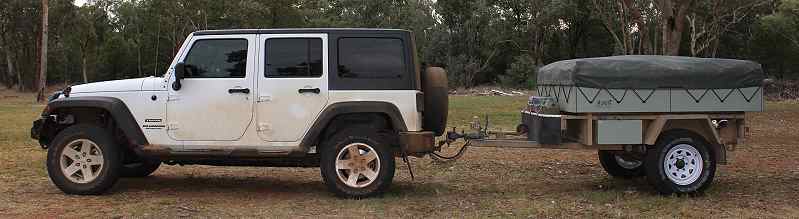
a
balanced rig
The vehicle is fitted
with a bullbar and winch, 70 litres of fuel,
fridge, misc gear & two people which gives the vehicle a total
loaded weight of
2360kg. In this situation as set out below, you are only
permitted to add 140kg ball weight to the vehicle to reach
the vehicle manufacturers 2500kg GVM capacity.
|
vehicle manufactures max specs |
vehicle manufactures max tow specs |
|
Gross Vehicle
Mass -
Tare -
max payload - |
2500kg 2000kg
500kg
|
Gross Trailer
Mass on road -
Gross Trailer
Mass off road -
ball -
not actual
manufacturers figures |
2300kg 1000kg
170kg |
|
 |
|
vehicle weights |
camper weights |
|
steel bullbar & winch
-
two people -
70 litres of fuel -
fridge & misc gear -
payload -
Tare -
--------
total weight - |
60kg
180kg
70kg
50kg +
----------------
360kg
2000kg +
----------------
2360kg |
camper
weighs -
actual ball
weight -
figures
just to explain the scenerio |
1200kg 130kg
|
|
allows
for 140kg ball weight on the vehicle |
|
|
terms
Tare Mass - mass of a vehicle, other than a L-group
vehicle (motor cycle), ready for service, unoccupied and unladen,
with all fluid reservoirs filled to nominal capacity except for
fuel, which shall be 10 litres only, and with all standard
equipment and any options fitted.
Camper Trailer Tare Weight - is the
weight as it left the manufacturer (with all options fitted) and
is usually the weight without water in the tanks or gas bottles
filled.
Laden Mass - the mass of a vehicle
and its load borne on the surface on which it is standing or
running.
Unladen Mass - the mass of the
vehicle in running order unoccupied and unladen with all fluid
reservoirs filled to nominal capacity including fuel, and with
all standard equipment.
GVM - or Gross Vehicle Mass is the
maximum laden mass of a motor vehicle as specified by the
‘Manufacturer’.
GTM - or Gross Trailer Mass is the mass
transmitted to the ground by the ‘Axle’ or ‘Axles’ of the
trailer when coupled to a drawing vehicle and carrying its
maximum load approximately uniformly distributed over the load
bearing area, and at which compliance with the appropriate
Australian Design Rules has been or can be established.
ATM - or Aggregate Trailer Mass is the
total mass of the laden trailer when carrying the maximum load
recommended by the ‘Manufacturer’. This will include any mass
imposed onto the drawing vehicle when the ‘Combination
Vehicle’ is resting on a horizontal supporting plane.
GCM - or Gross Combined Mass is the value
specified for the vehicle by the ‘Manufacturer’ as being the
maximum of the sum of the ‘Gross Vehicle Mass’ of the drawing
vehicle plus the sum of the ‘Axle Loads’ of any vehicle capable
of being drawn as a trailer.
Manufacturer - the name of the
person or company who accepts responsibility for compliance with
the Australian Design Rules and to whom the ‘Compliance
Plate’ approval certificate is issued.
Load Capacity - the difference
between ‘GVM’ of the vehicle and its ‘Tare Mass’.
Payload of a vehicle includes the
occupants and cargo as well as any accessories such as bull bar,
tow bars, winches, roof racks and also includes the ball weight
of the trailer.
Recommended Ball Weight is the maximum allowable weight
permitted to be placed on the vehicle’s tow ball as recommended
by the tow bar manufacturer.
Axle Load - total load transmitted
to the road by all the tyres of all the wheels whose centres may
be included between 2 transverse parallel vertical planes less
than one metre apart.
Axle Group - either a ‘Single
Axle’, ‘Tandem Axle Group’, ‘Triaxle Group’, or ‘Close Coupled
Axle Group’.
Axle - one or more shafts
positioned in a line across a vehicle, on which one or more
wheels intended to support the vehicle turn.
by Rob
thanks to Alan Everingham for his input
november
2011
updated
july 2015